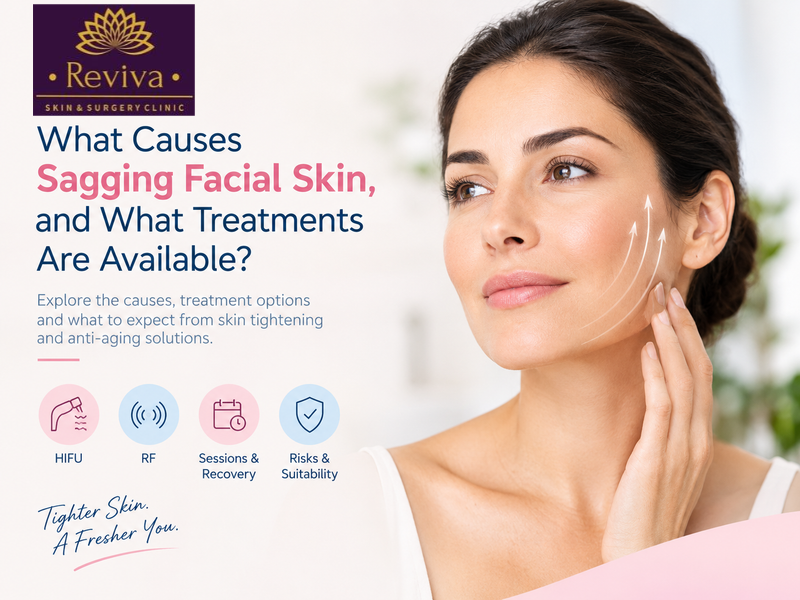
Who Benefits From Anti-Aging Treatment, and Who May Not
Most people start noticing changes in their 30s and 40s: fine lines around the eyes, a softer jawline, dull or uneven skin. Non-surgical treatments are generally aimed at early to moderate changes, not at reversing aging completely.
You may be a good candidate if you have mild to moderate laxity or fine lines, generally healthy skin, and realistic expectations of gradual, natural-looking improvement.
You may need a different approach, or to wait, if you are pregnant, have active acne, infection or open wounds in the treatment area, have an implanted electronic device or metal implant near the area, or have significant sagging that usually needs a surgical opinion. Your dermatologist will tell you if a treatment is unsuitable.
What Causes Skin to Age?
Skin ages from two directions. Intrinsic aging is the natural slowing of collagen and elastin production over time, influenced by genetics and hormones. Extrinsic aging comes from sun exposure, pollution, smoking, poor sleep and stress. In Delhi-NCR, UV exposure and air pollution make daily sun protection one of the most useful anti-aging steps. Our guide to choosing sunscreen for Noida weather covers this in detail.
Knowing the main driver helps. Surface damage, such as fine lines, uneven tone and rough texture, is treated differently from deeper laxity, where the skin has lost support.
Match the Concern to the Treatment
Fine lines and early texture changes
Dermatologist-guided skincare (sunscreen, retinoids, antioxidants), chemical peels and medical facials work on the skin’s surface. Fractional lasers can be considered for more visible texture changes, but they involve more downtime and are not right for every skin type.
Mild laxity and early jawline softening
This is where energy-based tightening treatments such as HIFU and RF are most often discussed. They work below the surface to stimulate collagen without incisions.
Deeper lines, folds and volume loss
These concerns are often better addressed with injectables or a combination plan. They are also the point where it is worth asking honestly whether a procedure can deliver what you expect.
Neck lines and double chin
The neck needs its own plan. See our article on neck lines and double chin reduction.
HIFU vs RF: How They Differ
Both are non-invasive skin tightening options, and both rely on controlled heat to prompt new collagen. The difference is in how and where the energy is delivered.
| HIFU (Micro-focused ultrasound) | Radiofrequency (RF) | |
|---|---|---|
| Energy type | Focused ultrasound | Electrical energy converted to heat |
| Where it works | Focused points at deeper layers, including the SMAS layer that surgeons address in a facelift | Heats the dermis more broadly |
| Best suited for | Mild to moderate laxity of the lower face, jawline, neck and brow | Mild laxity, skin firmness and texture |
| Sensation | Warmth, tingling or brief prickling with each pulse | Warmth, usually described as a hot-stone feeling |
| How results appear | Gradually, over about 2–3 months | Gradually, often needing a series of sessions |
A systematic review of micro-focused ultrasound studies concluded that it can tighten mildly to moderately lax facial skin (Systematic Review, 2023). Reviews also describe RF as a long-established tightening option with generally more modest lifting than ultrasound. Neither replaces a surgical facelift, and individual response varies.
For a full walkthrough of the procedure, read our guide to HIFU skin tightening: what to expect before, during and after.
Risks and Suitability
Non-invasive does not mean risk-free. Possible effects after HIFU or RF include temporary redness, swelling, tenderness or numbness. Less commonly, burns, blistering or pigmentation changes can occur, particularly if the device is used by an inexperienced operator or settings are not suited to your skin. Results are not guaranteed, and some people see only subtle change.
Before treatment, tell your doctor about your medical history, medications (especially blood thinners and acne medicines), pregnancy, previous fillers or threads, and any implants. Treatment decisions for Indian skin tones should also account for the risk of post-inflammatory pigmentation.
Sessions, Recovery and Aftercare
The number of sessions depends on the treatment and your skin. HIFU is often done as a single session, with a repeat considered later. RF is usually planned as a series. Your dermatologist will outline a plan after examining you.
Downtime is generally low. Most people return to normal activities right away, though mild redness or a warm feeling can last for a few hours to a couple of days. Aftercare typically includes gentle skincare, daily sunscreen, and avoiding harsh exfoliants until your doctor says it is fine. Tightening builds gradually, so judge results after a few months, not days.
What Affects Cost?
Treatment cost varies from person to person, and a fair estimate is only possible after consultation. The main factors are the area treated, the technology used, the number of sessions, whether treatments are combined, and the doctor’s assessment of your needs. Ask for a written plan that lists what is included. For a general breakdown, see our guide on what affects skin tightening cost in Noida and our overview of anti-aging treatments in Noida.
Questions to Ask Before You Choose a Clinic
- Who will examine me and perform the procedure, and what are their qualifications?
- Is this treatment suitable for my skin type and concern?
- What results are realistic for me, and what are the risks?
- How many sessions will I need, and what is the aftercare?
- What does the plan include, and are there cheaper or simpler alternatives?
Be cautious of clinics that promise guaranteed or dramatic results, push a package before examining you, or cannot explain the risks.
Where to Consult in Ghaziabad and Noida
Reviva Skin & Surgery Clinic offers dermatologist-led consultations at two locations:
- Ghaziabad: Shop No. S-1, Ground Floor, Quantum Homes, Raj Nagar Extension, Ghaziabad 201017.
- Phone: +91 7827448711
- Directions: Open Reviva Ghaziabad Clinic in Google Maps
- Noida: S No.-14 GF, Street 76 Market, Amrapali Silicon City, Gate No. 4, Sector 76, Noida.
- Phone: +91 8595856844
- Directions: Open Reviva Noida Clinic in Google Maps
Clinic timings differ by day, so please check the contact page or call before visiting. If you are unsure what to expect, our guide to your first dermatologist visit explains what to bring and ask.
Book a consultation and get a plan based on your skin, not a standard package.
FAQs
Which treatment suits fine lines and mild laxity?
Fine lines usually respond to sun protection, retinoids, peels or resurfacing. Mild laxity may suit HIFU or RF. Many people need a combination, and a dermatologist can recommend one after examining your skin.
How do HIFU and RF differ?
HIFU uses focused ultrasound to heat specific points at deeper layers, while RF heats the dermis more broadly using electrical energy. HIFU is typically considered for lifting the lower face and jawline, and RF for firmness and texture.
What results and downtime are realistic?
Expect gradual, modest tightening over a few months rather than a dramatic lift. Downtime is usually minimal, with temporary redness or tenderness possible. Results vary, and neither treatment replaces surgery.
Are these treatments safe for Indian skin?
HIFU does not rely on pigment-targeting light, but any heat-based treatment carries some risk. Safety depends on your skin, the settings used and the operator’s experience, so an in-person assessment matters.
How many sessions will I need?
It depends on the device and your skin. HIFU is often a single session with a possible repeat, while RF is usually a series. Your dermatologist will advise.
Where can I consult in Noida or Ghaziabad?
Reviva Skin & Surgery Clinic has consultations at Raj Nagar Extension, Ghaziabad and Sector 76, Noida. Please check timings on the contact page or call before visiting.